Bright and Beautiful Tamayo: Finding Frida's Camaradas
The Smith College Museum of Art is a squat, brick building situated at the northeastern corner of Smith College in Northampton, Massachusetts. On Sundays, parking is free on Elm Street, and the museum crowd thin, making it a perfect time to tour the collection. As I walked along the sidewalk toward the entrance, passing by the sparse group of students half my age, thoughts and emotions swirled within me. Changes in life happen instantly; the buildup may be a slow burn, but momentum takes over once the decision is made. Walking alone to the grey, concrete steps, I wondered how Frida made sense of the world, her body, and the situations she found herself in. I wondered how she handled heartbreak and loss, what her internal consciousness told her during her quiet moments to guide her through turmoil, especially with her and her husband’s relationship.
I pondered these questions because seven weeks ago, my partner and I went our separate ways. The life I had envisioned—that we had imagined together—suddenly evaporated from my future. I scrambled to pack, find a new home, move, and continue with work and school in my typical high-achieving mode (I am not sure this has been successful). Any of this is relevant because the Mexican restaurant I had planned to write about for this paper, with its colorful art on the walls, one of which depicted Frida, was no longer available to me. As of this week, I’ve been in my new home in the Pioneer Valley for precisely two weeks. Trying to find the local grocery and home goods store became a more pressing problem to solve, which came at the expense of finding where Frida or her Camaradas were hiding.
Yet, as I was reading the article by Xavier Villaurrutia about Rufino Tamayo, I couldn’t believe my serendipitous luck coming across that Tamayo has a mural at the Smith College Museum of Art, a mere twenty-five minutes from the little apartment I now find myself in. What luck! Could this be a light in the shadow that I was living in? Perhaps a bit dramatic, but it’s funny what gives you breath when you feel like an elephant is sitting on your chest. A small kindness to find artwork that fulfills a school assignment and to find an artist who came across as a gentle soul.
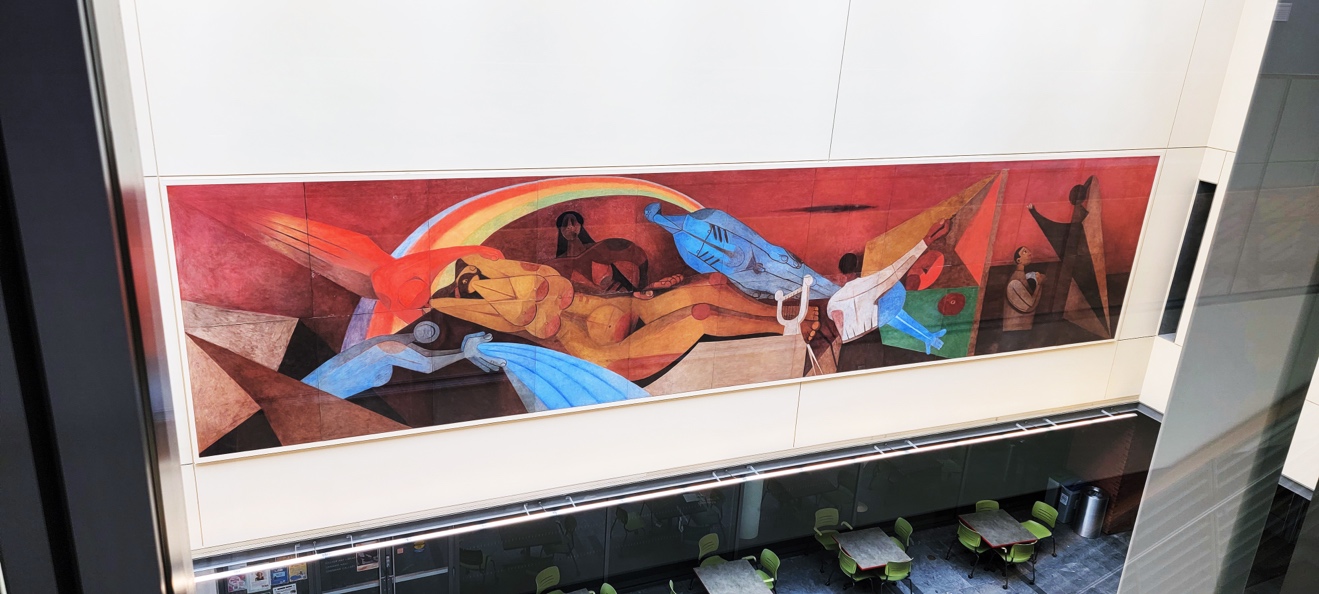
I paid for my ticket and walked to the stairs, noting that art after 1800 from the Americas and Europe was on the third floor. As I peeled my eyes away from the museum map in my hands, navigating past the second floor, I looked to my left, through the expanse of glass cutting off a student atrium with the museum proper. The bright reds and cerulean of a large fresco mounted to the wall opposite leaped out at me. I realized that this was Tamayo’s Nature and the Artist: The Work of Art and the Observer (1943) work and a smile as wide as the hole in my heart spread across my face.
Tamayo’s fresco, as noted in the wall text on the third floor, is meant to be viewed from left to right, with the inspiration of Nature shown on the left side of the fresco, which segues into the act of creation in the middle, to the culmination of an individual viewing the final piece of art. The fresco is large at forty-three feet wide and nine feet tall, and its current installation differs from where it originally was painted. The Smith College commissioned Tamayo in 1943 to paint the fresco in honor of Elizabeth Cutter Morrow, who spent a year as Smith’s president. Her husband, Dwight Morrow, was a U.S. ambassador to Mexico, and the two of them lived in Mexico for three years. It didn’t come as a surprise that I could find one of Frida’s cohorts here in western Massachusetts at an American University after reading about the connections. Unfortunately, the museum this past week was half shut down—the entire second floor shuttered—and the docent I spoke with regarding the fresco couldn’t offer much more information than what was written on the wall text.
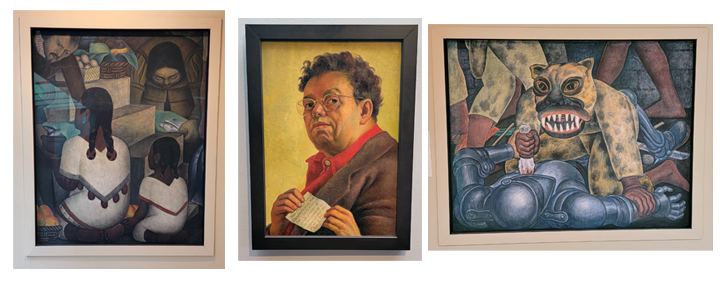
Next to Tamayo’s placard explaining his fresco hung a few panels of Diego Rivera’s frescos—Market Scene (1930) and Indian Warrior (1931). I noted how the panels were smaller, portable pieces of the larger fresco, and the two had similar themes of violence, subjugation, and coercion. These panels such a stark contrast to Tamayo’s bright and airy fresco. I knew Rivera’s Self-Portrait (1941) was in the main gallery, so I strolled over to the painting, viewing pieces by Matisse, van Gogh, Monet. After taking a few photos and reading the wall text for Self-Portrait, Frida again came back to my mind. How did she do it, being drawn to a man that wasn’t always good for her? How does a woman continuously break herself against the person she loves? Where did Frida find the strength to endure such a life?
Walking back down to the second floor, I stood facing the fresco again. I put my phone away since I had already taken a few photographs. I placed my hands on the railing. I breathed in, keeping my eyes wide on the fresco. Sun poured into the atrium, and the chilliness of the main gallery was replaced with an invisible embrace of warmth. Tamayo’s fresco spoke to me, reminded me of the elemental nature of creation, of the joy that comes with love and pursuit, of the need for solitude to tap that wild river of creativity each human possesses, of pursuing the things we want to bring into the world in our solitude. At that moment, standing in front of Tamayo’s fresco, which hangs in a place of vibrancy and learning, fresh starts and first steps, I breathed in his colors and breathed out the greyness that had embalmed me over the past months. Heartache had no place here in front of such beauty.
I had hoped to find something of Frida’s in the museum, but that did not happen. Even checking the collections database online upon arriving home, there were no works to be found by Frida in the five colleges located here in Pioneer Valley. I wanted to see Frida’s brush strokes, stand close enough to the painting to see the ridges and valleys, understand how she blended color, to take a look at the rawness on the canvas. I was initially sad to know there isn’t an easy way to see Frida. But then, I realized it’s just another thing I can look forward to finding out about in my new city. I can still go out and find Frida.
Works Cited
Rivera, Diego. Indian Warrior. 1931, Smith College Museum of Art, Northampton.
—. Market Scene. 1930, Smith College Museum of Art, Northampton.
—. Self-Portrait. 1941, Smith College Museum of Art, Northampton.
Tamayo, Rufino. Nature and the Artist: The Work of Art and the Observer.
1943, Smith College Museum of Art, Northampton.
“The Work of Art: Months to create, years to conserve, days to install—mural again at Smith College.” Smith College, 1 Mar. 2005, www.smith.edu/newsoffice/releases/04-058.html. News Release.
Villaurrutia, Xavier. “Rufino Tamayo.” Images of Mexico: The Contribution of Mexico to 20th Century, edited by Erika Billeter. Canvas, uploaded by Dr. Maria Luisa Parra, https://canvas.harvard.edu/courses/112840/modules/items/1263433.
Wall text for Nature and the Artist: The Work of Art and the Observer. Smith College Museum of Art, Northampton.