Frida as Guide, Frida as Friend
If someone had told me at the beginning of this semester that Frida Kahlo would both empower and heal me in the coming four months of my life, I would have thought them mad. Frida was someone I had a passing familiarity with, thinking I had little in common with a petite Mexican painter alive during the first half of the twentieth century. However, learning about Frida’s struggles with her body and being at odds with it, dealing with chronic pain, her inability to have children, and embodying what we may now term as the “queer lifestyle” (Blakewell notes that she “had several extramarital affairs with both men and women” (169)), I discovered that Frida Kahlo and I were more similar than we were different. What a revelation!
My piece of artwork, if we may use the charitable description of the word artwork, is my interpretation of Frida Kahlo’s I am disintegration (1953) painting in her diary, using my own heartache and the post-breakup tumult as fodder for the piece. It is dominated by a blue background, ranging in hues from dark blue at the bottom of the canvas to a lighter blue that still represents the night, the color a subtle nod to Frida’s La Casa Azul. Slightly off-center is a face meant to represent me, the painter. The skin is the color of clay dirt, and the green eyes stare directly at the viewer. The face betrays no emotion, though the two teardrops, one coming out from each eye, indicate the sadness present. Across Frida’s paintings, her self-portraits show “a challenging face with a single, batwing eyebrow and a look of stoicism, vividly theatrical, deeply solitary” (Benson).
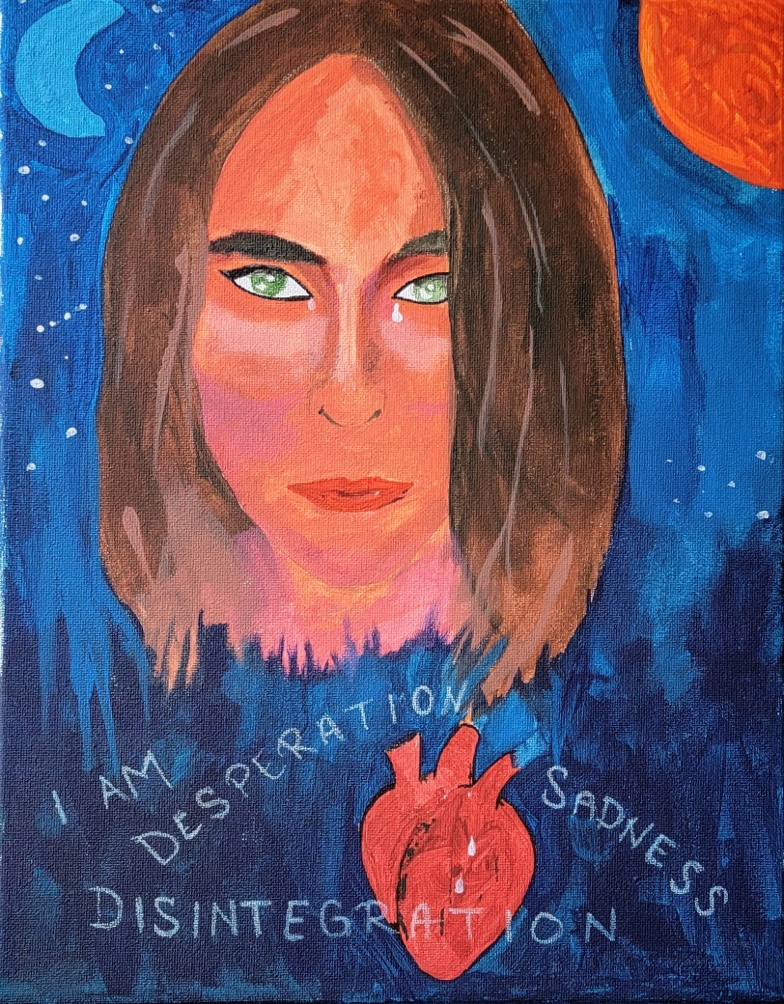
Below the floating face, a semi-realistic heart hangs suspended outside of my body. It, too, has two teardrops secreting out of the flesh of the heart. Kahlo often included renderings of realistic-looking hearts, some grotesquely pumping blood or physically broken, which can be seen in the paintings like Memory, the Heart (Kahlo 1937) and The Two Fridas (Kahlo 1939), to name just two. In both these paintings, Frida’s face and heart are representative of her internal pain around her relationship with Diego Rivera. Specifically, in The Two Fridas painting, Frida “admitted it expressed her desperation and loneliness with the separation from Diego” (The Two Fridas, 1939 by Frida Kahlo). Including the heart in my painting gives a visual representation of my pain, the proverbial heart ripped from my chest cliché often used when discussing relationships ending. In reverence to Frida, I included her words, and a few of my own, around and over my heart: I am disintegration, desperation, sadness.
In the upper section of the painting, a crescent moon is on the left side, and a section of the sun is on the right, brush strokes layered on top of each other to represent the swirling mass of molten heat. These two elements of the painting represent duality and opposing forces. These elements are also common in Frida’s paintings, as well as Rufino Tamayo’s, who is my favorite artist, other than Frida, from this semester. Two of Tamayo’s paintings—Dualidad (1964) and Luna y Sol (1990)—encapsulate these themes of duality: light and dark, day and night, male and female, abled and disabled bodies, humankind and nature, happy and sad. The stars in the sky of my painting are also meant to represent the sky itself weeping for my loss.
What has most impressed me about Frida is how she did not retreat from living a full life, despite the numerous physical and emotional issues she encountered in that short life. While I was going through my breakup, we began to dive deeper into who Frida was, her love for her native home, and how she handled the riotous nature of her and Diego’s relationship. It was illuminating to move through my loss while studying the history of Frida and her Mexico. Frida was a passionate woman—a passionate Mexican woman. She did not shy away from displays of emotions. If the 2002 film Frida is in any way accurate, Frida’s emotions ran on the surface of her skin, and her outbursts toward Diego were wild and voracious. They could end up being physical, such as in the scene when she catches her sister, Cristina, sleeping with her husband. Like Frida, I come from a long line of passionate, fiery women, though my lineage is of the Irish-Italian variety. We are known for vocalizing our opinions and emotions, especially in matters of the heart, which comes out in both physical and emotive gestures. In my experience— perhaps Frida encountered the same—those less passionate and more reserved than us often have difficulty navigating a person with such intensity (some may even use the term volatility). Diego was more reserved than Frida, just as my ex-partner had been more reserved than me. Furthermore, rather than adapting to what those around her needed, Frida carved out her own space and trusted herself to share the internal strife represented in her paintings. Frida did not back down. She did not allow the things that happened to her to dictate what she did with her life.
The words I am disintegration became my mantra for the first month after the breakup. That image in her diary played on a loop in my mind, the words written on my mind’s chalkboard over and over, the replaying of the relationship and heartache like a sick movie just for me. As I repeated those words over and over, there was a part of me that was able to touch Frida’s own pain. Empathy is a powerful gift, though sometimes it can be too much (my third-grade teacher told my mother, “I worry about Nikki. Her heart is too open, and the world is too hard for such a sensitive soul.”). In some way, being able to drop myself into Frida’s shoes allowed me to process the breakup much more quickly (that and therapy). Frida endured so much. She relied on others in a way I find hard to fathom due to the necessity of her body’s needs. She took that pain, and instead of it burying her, it became her source of connection and inspiration. Frida painted her pain.
Initially, my final art project would be a mini magazine, a reflection on all I learned and gained from the semester, with a smattering of Rufino Tamayo. But understanding that healing comes from making the uncomfortable visible and processing it directly, which I learned from Frida, I decided to paint my pain. While the artwork is not anything like Eler’s (wow! What a painting!), the simple motions of laying down paint on the canvas, the slow and deliberate process over hours and days, looking at the painting drying in between sittings, all helped in moving through the breakup. As I stated in class, if I were to begin another painting, the words on the canvas would be “I am joy.”
Works Cited
Bakewell, Liza. “Frida Kahlo: A Contemporary Feminist Reading.” Frontiers: A Journal of Women Studies, vol. 13, no. 3, 1993, pp. 165–89. JSTOR, https://doi.org/10.2307/3346753. Accessed 23 April 2023.
Benson, Sheila. “Frida Kahlo: From Cult Figure to Mainstream Culture: With the tormented Mexican artist’s works in demand and four films pending, will we lose Frida?: [Home Edition].” Los Angeles Times (pre-1997 Fulltext), May 21, 1991, pp. 1. ProQuest, http://search.proquest.com.ezp-prod1.hul.harvard.edu/newspapers/frida-kahlo-cult-figure-mainstream-culture-with/docview/281280687/se-2. Accessed 11 May 2023.
Frida. Directed by Julie Taymore, performances by Salma Hayek, Alfred Molina, Geoffrey Rush, Valeria Golino, Mia Maestro, Roger Rees, Antonio Banderas, and Edward Norton, Miramax Films, 2002.
Herrera, Hayden. Frida Kahlo: The Paintings. 1991.
Kahlo, Frida. I am disintegration. 1953. Google Arts and Culture, https://artsandculture.google.com/asset/p%C3%A1gina-del-diario-de-frida-kahlo-frida-kahlo/XgEuN8afpPttDQ?childAssetId=KQEWyOz6Br6Hsg.
Tamayo, Rufino. Dualidad. 1964. The Art Story: Rufino Tamayo, https://www.theartstory.org/artist/tamayo-rufino/. Accessed 11 May 2023.
—. Luna y Sol. 1990. . The Art Story: Rufino Tamayo, https://www.theartstory.org/artist/tamayo-rufino/. Accessed 11 May 2023.
The Two Fridas, 1939 by Frida Kahlo. www.fridakahlo.org/the-two-fridas.jsp. Accessed 12 May 2023.